| Author |
 Topic Search Topic Search  Topic Options Topic Options
|
Adam Blundell 
Presidency


Joined: June 24 2002
Location: Davis County
Status: Offline
Points: 18526
|
 Post Options Post Options
 Thanks(0) Thanks(0)
 Quote Quote  Reply Reply
 Posted: February 02 2017 at 9:35am Posted: February 02 2017 at 9:35am |
 evan127 wrote: evan127 wrote:
Mark Peterson wrote:
Xenia can handle some excess of pollution but an Ammonia level of .25 is a problem for all marine animals. Frankly, I would have advised against adding the new coral just yet, but since they are mushrooms, most of them will probably survive.ÂÂ
The tank appears to have been set up quite recently and by the look of it, I suspect the rock was dry dead LR. The high Ammonia is probably due to the rock and it won't go away on its own for a while. There are two items/products that can help remove Ammonia and other pollution the rock is producing and will produce for the next 6-12 months. The one I like best is called Poly-Filter, but unfortunately it's not available at LFS. The last time I ordered, I bought extra Poly-Filter just for this kind of situation, just to share with you and others in the same boat.   Contact me at 808-345-1049
Aloha, Mark  
P.S. At the young age of this tank, I can guarantee that Alk, Ca and Mg are still within range. Those won't need to be tested for another month or two, but if I were you, I'd put the Red Sea Reef Foundation Pro test kit in the budget. |
But the new corals will start consuming alkalinity and calcium once added. Even for a new tank, adding quadruple the amount of coral, the alkalinity and calcium should decrease rapidly and should be tested for a few times a week and supplemented through two part or water changes if it matches consumption adequately. |
Somewhat true. But for non calcification corals the amount of calcium and alkalinity used is negligible. Same true for nearly all frags. I'd be more concerned about the effects of growing coraline algae. But I too think you wouldn't need to test for several months. Adam
|
|
Come to a meeting, they’re fun!
|
 |
chuckfu5
Presidency
Joined: April 19 2015
Location: Ogden
Status: Offline
Points: 483
|
Post Options
Thanks(0)
Quote Reply
Posted: February 02 2017 at 2:59pm |
Since the tank cycled I have been doing bi weekly water changes. Aprox 5-6 gallons every other week. This tank is only 13.5 gallons.
I'll check calcium and Alkalinity this weekend.
Another really weird question....I have a small bubble tip that has been somewhat hosting a bangai Cardinal. He doesn't get into the anemone like a clown would but he brushes through the anemone several times through out the day and sleeps right next to him.
This is odd behavior I thought.....anyone ever experience anything similar?
I'll get a picture up soon.
Edited by chuckfu5 - February 02 2017 at 3:00pm
|
|
Mark Peterson
Paid Member

Joined: June 19 2002
Location: Murray
Status: Offline
Points: 21437
|
Post Options
Thanks(0)
Quote Reply
Posted: February 02 2017 at 5:06pm |
It's not strange at all. Lot's of different fish will host in anemones.
What I have to say below, I hope doesn't come across as too bad of news, but if you would like to make your reefkeeping experience enjoyable and not a headache, please read on.
The anemone will probably move again, for two reasons. First, removing the sock from the pump has increased/changed the water flow in all areas of the tank. Anemones are prone to move when flow changes. Second, in a new tank conditions are constantly changing/evolving as animals(bacteria, worms bugs, etc.) and algae start to grow more dense. This not only changes the levels of chemistry that we know and can test, but all sorts of biological and chemical processes that we don't test. One process that has been identified is a cycle belonging to Sulfur. I have posted a pic below showing an effective defense against an anemone getting sucked into a pump strainer. It's a larger cage surrounding the pump strainer made of Needlepoint Plastic Canvas, sewn together with fishing line. It's purpose in that tank was to prevent algae from clogging the intake.
In my experience a new tank should not need to have that large or that frequent of water changes. In my set up of new tanks I don't have to bother with water changes for the first two months and yet I have fish and coral from the second week. Unfortunately the actual "cycling of this tank is nowhere near complete. If not for those 50% biweekly W/C's the real Ammonia level would probably be double or more. I believe I have suggested it twice now, a couple weeks ago you were going to call me to discuss, that dead rock is wrecking havoc on this new tank. It will continue to do so for at least 6 months. There is a solution to the problem and I'm holding it for you. 808-345-1049 Aloha, Mark
|
Reefkeeping Tips, & quick, easy setup tricks:www.utahreefs.com/forum/forum_posts.asp?TID=9244 Pay it forward - become a paid WMAS member 
|
|
chuckfu5
Presidency
Joined: April 19 2015
Location: Ogden
Status: Offline
Points: 483
|
Post Options
Thanks(0)
Quote Reply
Posted: February 02 2017 at 7:00pm |
|
Mark.....i did no water changes until the ammonia and Nitrites tested 0. I waited a few more days did another test and it was at 0 that's when I did the water change.
Tests as of tonight are as follows
Ammonia 0
Nitrite 0
Nitrate 5
Ph 8.2
Calcium was high...around 500...im assuming because of the newness of the tank there isn t much using it
Alkalinity 9 DKH
Phosphates were not detectable.
This rock was dead for years. It wasn't something that was pulled from a tank for a couple of weeks or a month and then put in. I would assume everything would have have been long dead and not putting any harmful effects into the water.
As far as the anemone and moving I'm aware that with the increased water flow I run the risk of him moving but the sock on the powerhead was producing micro bubbles and also not allowing the filter media to do its job effectively.
Does anyone else besides Mark have the same concerns? I'm a little confused as to why I need the ammonia pads if I'm testing at zero besides directly after adding the clowns?
|
|
chuckfu5
Presidency
Joined: April 19 2015
Location: Ogden
Status: Offline
Points: 483
|
Post Options
Thanks(0)
Quote Reply
Posted: February 02 2017 at 7:36pm |
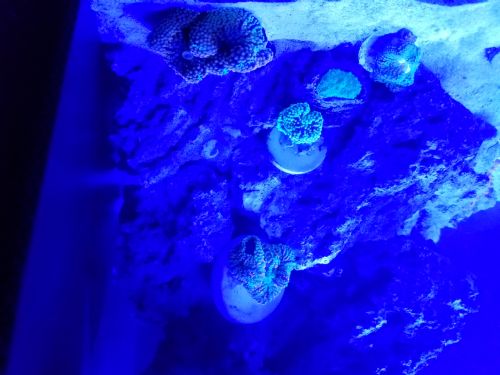 As promised the Ricordia's doing great. Pic is upside down...
Edited by chuckfu5 - February 02 2017 at 7:36pm
|
|
Mark Peterson
Paid Member
Joined: June 19 2002
Location: Murray
Status: Offline
Points: 21437
|
Post Options
Thanks(0)
Quote Reply
Posted: February 03 2017 at 9:49am |
Awesome that Ammonia is at zero.
Just FYI, 500 ppm Calcium is not too high. It can even go as high as 600 ppm without causing trouble in the short run. The range for Ca in my book is 350-500 ppm
You said, "This rock was dead for years. It wasn't something that was pulled from a tank for a couple of weeks or a month and then put in. I would assume everything would have have been long dead and not putting any harmful effects into the water."
You have misunderstood. The amount of time that LR has been out in the air does not matter. The dead matter is still in the rock. It's when the rock is placed back into a tank that new bacteria begins to decompose the dead stuff, releasing all sorts of different polluting compounds back into the tank water, including heavy metals. Gradual decomposition is also why it can continue to pollute the tank for up to 12 months as the bacteria slowly works its way to the innermost regions of the rock.
Commenting on your comment - I explained and even showed a pic of how to protect an anemone from getting into a pump in a way that causes no issues with flow, bubbles, etc.
Then you said, "Does anyone else besides Mark have the same concerns?"
Of course nobody else has these concerns. My experience in this hobby is a little bit more extensive than most. And for me it's not only a hobby, it's a profession.
Lastly, you said, "I'm a little confused as to why I need the ammonia pads if I'm testing at zero besides directly after adding the clowns?" Ok, I see that you misunderstood this as well. Poly-filter is a product that adsorbs all sorts of pollution, especially the stuff that comes out of pieces of dead LR that are trying to recover in your tank. Not all dead LR is the same. A piece of bare white LR like that purchased at an LFS has a hundred times less life in it than a piece of "lively" LR that has been growing for years in a healthy reef aquarium. If the difference is not clear, look closely at the LR in a long established tank, especially noting if it has Sponge growth. Sponge is an indicator that a piece of LR harbors a large population of bacteria, bugs and worms.
Some hobbyists have used dead LR and had no troubles at all. They will say I'm crazy. Yes, I am a little crazy, but they are simply lucky. The dead rock they used was like the barren white LFS rock I described above, which has very little dead matter in it. Maybe if you're lucky, your rock fits this description.
Aloha, Mark
P.S. I mean no disrespect to LFS regarding barren LR. That's how they sell it. It's more economical for an LFS to carry LR in that condition.
Edited by Mark Peterson - February 03 2017 at 9:58am
|
Reefkeeping Tips, & quick, easy setup tricks:www.utahreefs.com/forum/forum_posts.asp?TID=9244 Pay it forward - become a paid WMAS member
|
|
chuckfu5
Presidency
Joined: April 19 2015
Location: Ogden
Status: Offline
Points: 483
|
Post Options
Thanks(0)
Quote Reply
Posted: February 03 2017 at 6:48pm |
Mark Peterson wrote:
Awesome that Ammonia is at zero.Â
Just FYI, 500 ppm Calcium is not too high. It can even go as high as 600 ppm without causing trouble in the short run. The range for Ca in my book is 350-500 ppm
You said, "This rock was dead for years. It wasn't something that was pulled from a tank for a couple of weeks or a month and then put in. I would assume everything would have have been long dead and not putting any harmful effects into the water."
You have misunderstood. The amount of time that LR has been out in the air does not matter. The dead matter is still in the rock. It's when the rock is placed back into a tank that new bacteria begins to decompose the dead stuff, releasing all sorts of different polluting compounds back into the tank water, including heavy metals. Gradual decomposition is also why it can continue to pollute the tank for up to 12 months as the bacteria slowly works its way to the innermost regions of the rock.Â
Commenting on your comment - I explained and even showed a pic of how to protect an anemone from getting into a pump in a way that causes no issues with flow, bubbles, etc.Â
Then you said, "Does anyone else besides Mark have the same concerns?" Â
Of course nobody else has these concerns. My experience in this hobby is a little bit more extensive than most. And for me it's not only a hobby, it's a profession.
Lastly, you said, "I'm a little confused as to why I need the ammonia pads if I'm testing at zero besides directly after adding the clowns?"Â Ok, I see that you misunderstood this as well. Poly-filter is a product that adsorbs all sorts of pollution, especially the stuff that comes out of pieces of dead LR that are trying to recover in your tank. Not all dead LR is the same. A piece of bare white LR like that purchased at an LFS has a hundred times less life in it than a piece of "lively" LR that has been growing for years in a healthy reef aquarium. If the difference is not clear, look closely at the LR in a long established tank, especially noting if it has Sponge growth. Sponge is an indicator that a piece of LR harbors a large population of bacteria, bugs and worms.
Some hobbyists have used dead LR and had no troubles at all. They will say I'm crazy. Yes, I am a little crazy, but they are simply lucky. The dead rock they used was like the barren white LFS rock I described above, which has very little dead matter in it. Maybe if you're lucky, your rock fits this description.Â
Aloha, Mark Â
P.S. I mean no disrespect to LFS regarding barren LR. That's how they sell it. It's more economical for an LFS to carry LR in that condition.
|
So since Mark knows everything and no one else can have a comment because they know no better I'm leaving this club. Thanks Mark.... Will an Admin please delete my account.
|
|
Adam Blundell
Presidency
Joined: June 24 2002
Location: Davis County
Status: Offline
Points: 18526
|
Post Options
Thanks(0)
Quote Reply
Posted: February 03 2017 at 9:24pm |
|
I think I agree with Marks assessment. More importantly a thousand other people here are welcome to chime in and help.
Adam
|
|
Come to a meeting, they’re fun!
|
|
shaggydoo
Guest


Joined: April 17 2005
Location: Sandy
Status: Offline
Points: 903
|
Post Options
Thanks(0)
Quote Reply
Posted: February 04 2017 at 12:02am |
|
I generally agree with what Mark says, but please don't leave. You will learn that everyone has insights and experiences that may or may not work for you. Read and read and read and research. Mark has a lot of experience, but he still says things that are questionable (as do us all). For example: "The amount of time that LR has been out in the air does not matter. The dead matter is still in the rock" Decomposition happens to all organic matter in air, land, water, or anywhere else where bacteria and other organisms are available to break the material down. Your dead rock won't magically break down in water versus air, but the process may take different times depending on the environment.
|
|
60g LPS Cube
|
|
Mark Peterson
Paid Member
Joined: June 19 2002
Location: Murray
Status: Offline
Points: 21437
|
Post Options
Thanks(0)
Quote Reply
Posted: February 04 2017 at 10:45am |
When I first got into this hobby I knew nothing about it and there was no internet. I researched in all the books I could find and asked questions of the experts that we would bring in as guest speakers. Slowly I began to put it all together. There was so much to know, but I loved it and became very passionate about the hobby. I was continually misunderstanding the scientific principles of it. What I thought I knew was constantly being replaced with better understanding. By the time the internet came about, I had become one of the guys that had a lot of the answers but I was constantly being humiliated by my limited knowledge and lack of tact.
I know it's frustrating sometimes. Don't give up. Just try to keep learning.
Aloha, Mark |
Reefkeeping Tips, & quick, easy setup tricks:www.utahreefs.com/forum/forum_posts.asp?TID=9244 Pay it forward - become a paid WMAS member
|
|
evan127
Guest

Joined: November 13 2009
Location: Downtown
Status: Offline
Points: 1342
|
Post Options
Thanks(0)
Quote Reply
Posted: February 04 2017 at 1:57pm |
|
Then you said, "Does anyone else besides Mark have the same concerns?" Â
Of course nobody else has these concerns. My experience in this hobby is a little bit more extensive than most. And for me it's not only a hobby, it's a profession.
- Just because you have been in the hobby longer than most, does not mean others can't share the same concerns or have some of their own.
Lastly, you said, "I'm a little confused as to why I need the ammonia pads if I'm testing at zero besides directly after adding the clowns?"Â
Ok, I see that you misunderstood this as well. Poly-filter is a product that adsorbs all sorts of pollution, especially the stuff that comes out of pieces of dead LR that are trying to recover in your tank. Not all dead LR is the same. A piece of bare white LR like that purchased at an LFS has a hundred times less life in it than a piece of "lively" LR that has been growing for years in a healthy reef aquarium. If the difference is not clear, look closely at the LR in a long established tank, especially noting if it has Sponge growth. Sponge is an indicator that a piece of LR harbors a large population of bacteria, bugs and worms.
Some hobbyists have used dead LR and had no troubles at all. They will say I'm crazy. Yes, I am a little crazy, but they are simply lucky. The dead rock they used was like the barren white LFS rock I described above, which has very little dead matter in it. Maybe if you're lucky, your rock fits this description.Â
- Doesn't seem like the question was answered here regarding ammonia pads. I don't think it's necessary to add a filter media for ammonia specifically. Good flow and gas exchange while keeping up with your good husbandry should take care of any ammonia issues with you current bioload.
- I started my 120 gallon tank with dry rock, never been in an artificial reef mined from the earth kind of dry rock. I also added mature rock from my old 48 gallon reef that had the same type of dry rock put in it when it was new. Today, 3 months after I set up my 120 with 3/4 of dry rock and 1/4 of live rock, I have sponges galore and the rock is equally dark. I've never added any live rock into any of my systems and the reef is littered with sponge, pods, etc. They will somehow find their way into your system, though it might take longer to do so. I decided to add clean dry rock (not previously used in an artificial reef and dried out) to prevent any sort of pests like acropora eating flatworms, red bugs, nudibranchs, algae, organics, etc from entering my system. This prolonged my cycle and promoted a few bacterial blooms, but in the end I know I most certainly did not add any foreign organics, pests, etc. into my system.
|
|